


The Diablo 4 Lord of Hatred expansion is introducing one of the most anticipated additions to the game since launch — set items. But they're not arriving in the way most players expected. Instead of traditional armor or weapon sets, Diablo 4 is implementing sets through a brand-new system called the Talisman. This system adds an entirely separate layer of build customization that doesn't compete with your existing gear slots, and it brings with it new item types called seals and charms. From permanent shadow clones to werebear companions, the early reveals suggest this system will open up some wild new possibilities for every class.
Here's everything we know so far, organized by the questions players are asking most.
Diablo 4 Talisman System in Lord of Hatred
The Talisman is a new endgame progression system arriving with the Lord of Hatred expansion. It lives in its own dedicated tab within your inventory, a completely separate UI panel that doesn't replace or interfere with any of your current gear slots.
You'll still be wearing your mythics, uniques, and legendaries. The Talisman exists alongside your normal itemization, giving players an additional layer of power and build customization without forcing trade-offs against their equipped gear.
This is also the system through which set items are being introduced to Diablo 4 for the first time.
How Does the Talisman Work?
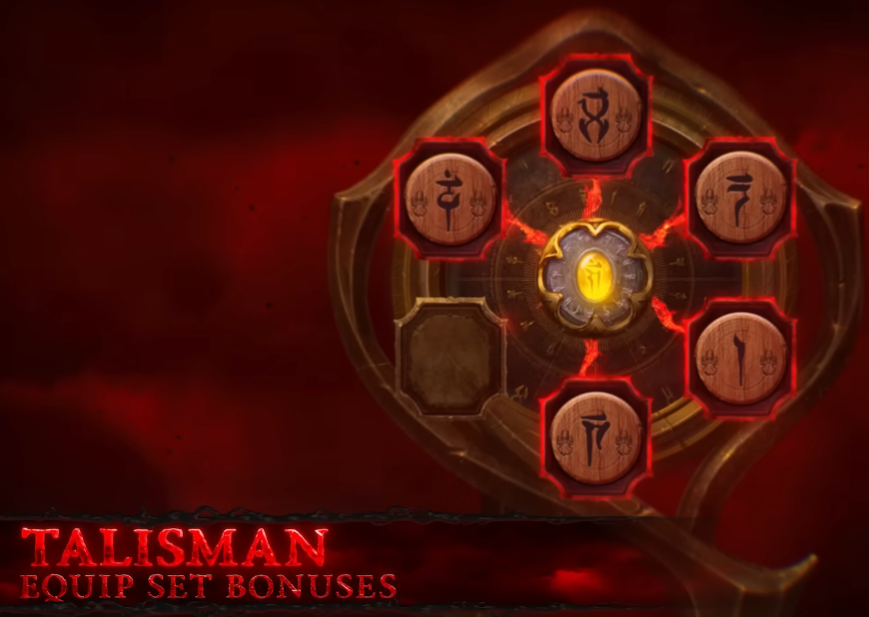
The Talisman interface consists of seven total sockets arranged in a specific layout:
One central socket - this is where you place a seal, which acts as the anchor for the entire system.
Six outer sockets are arranged in a hexagonal pattern - these are where you slot in charms.
The seal you place in the center determines how many of the outer charm sockets become available and what types of charms you can equip. Not every seal will open all six outer sockets, so the seal you choose has a direct impact on how you build out the rest of the Talisman.
Talisman Seals
Seals are the new item type that goes into the Talisman's central socket. They serve as the foundation of your entire Talisman setup because they control several things at once.
The Seal Controls Your Socket Count
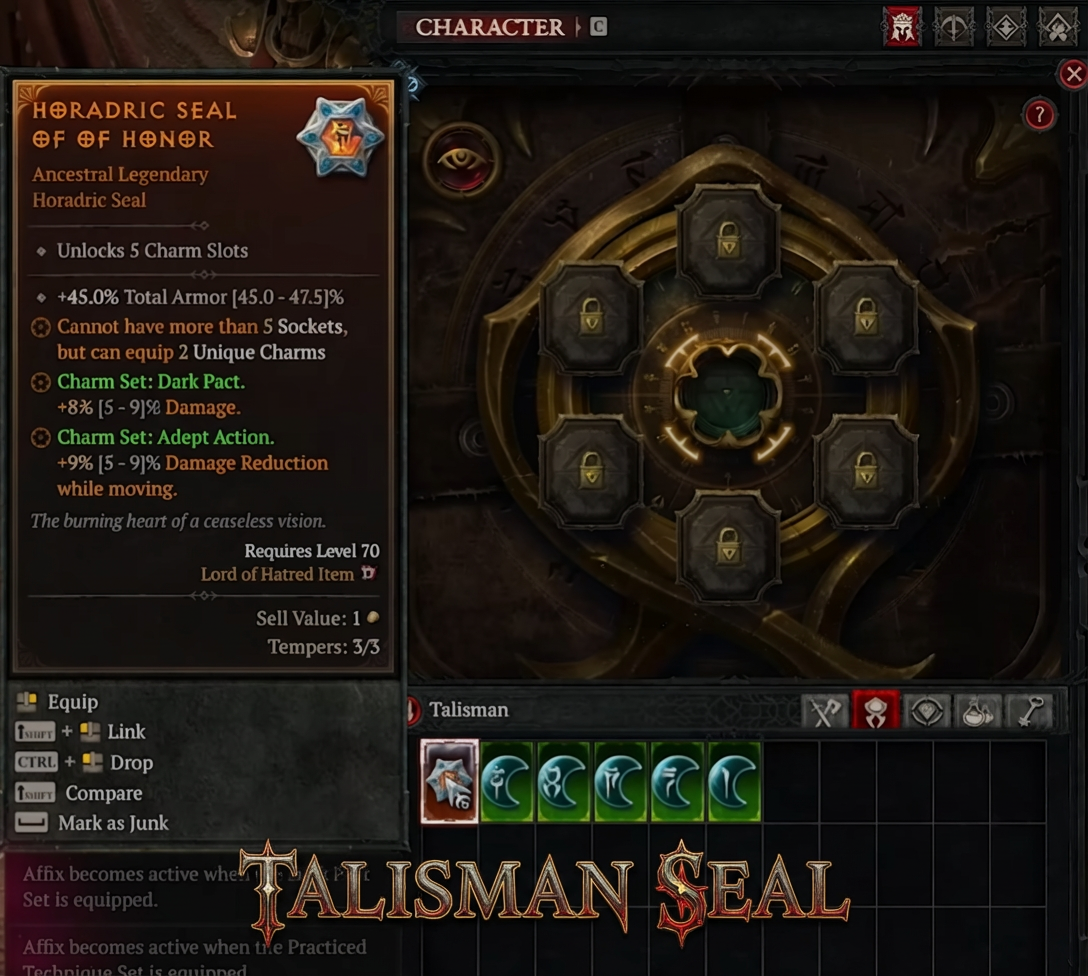
The one seal shown so far - the Horadric Seal of Honor, an ancestral legendary seal - opens five of the six outer charm sockets. That means one socket stays locked when using this particular seal. Different seals will presumably offer different socket counts, though we haven't seen one that opens all six yet.
Seals Determine How Many Unique Charms You Can Use
This specific seal has the effect: "Cannot have more than five sockets, but can equip two unique charms." So your seal dictates not just how many charms you can slot in, but also how many of those charms can be unique-rarity items. This creates interesting trade-offs between running full set bonuses versus mixing in powerful unique effects.
Seals Have Affixes
The Horadric Seal of Honor has a single affix roll, total armor up to 49.5%. It's unclear if all seals will have just one affix or if some could roll multiple. The affixes shown so far lean toward defensive or utility stats.
Seals Can Buff Specific Sets
One of the more interesting features is that seals carry bonus effects tied to specific charm sets. The revealed seal offers up to 9% increased damage if you're using the "Dark Pact" charm set, and up to 9% damage reduction while moving if you're using the "Adapt Action" charm set.
According to the developers, this is intentional. They want to give players a reason to mix and match multiple sets, say a three-piece and a two-piece, rather than always defaulting to a full five-piece set bonus. These seal bonuses serve as extra incentives for running split-set configurations.
Talisman Charms
Charms are the second new item type, and they fill the six outer sockets of your Talisman. These are the items that carry set bonuses, affix rolls, and, in the case of unique charms, the unique effects from converted gear pieces.
Charms Come in Multiple Rarities
Charms will span most of the existing rarity tiers in the game, including legendary, unique, and the new set rarity. There has been no confirmation of mythic-rarity charms so far. Lower rarities below legendary should also exist, giving players a natural progression path as they farm better versions.
Each Charm Has Affix Rolls
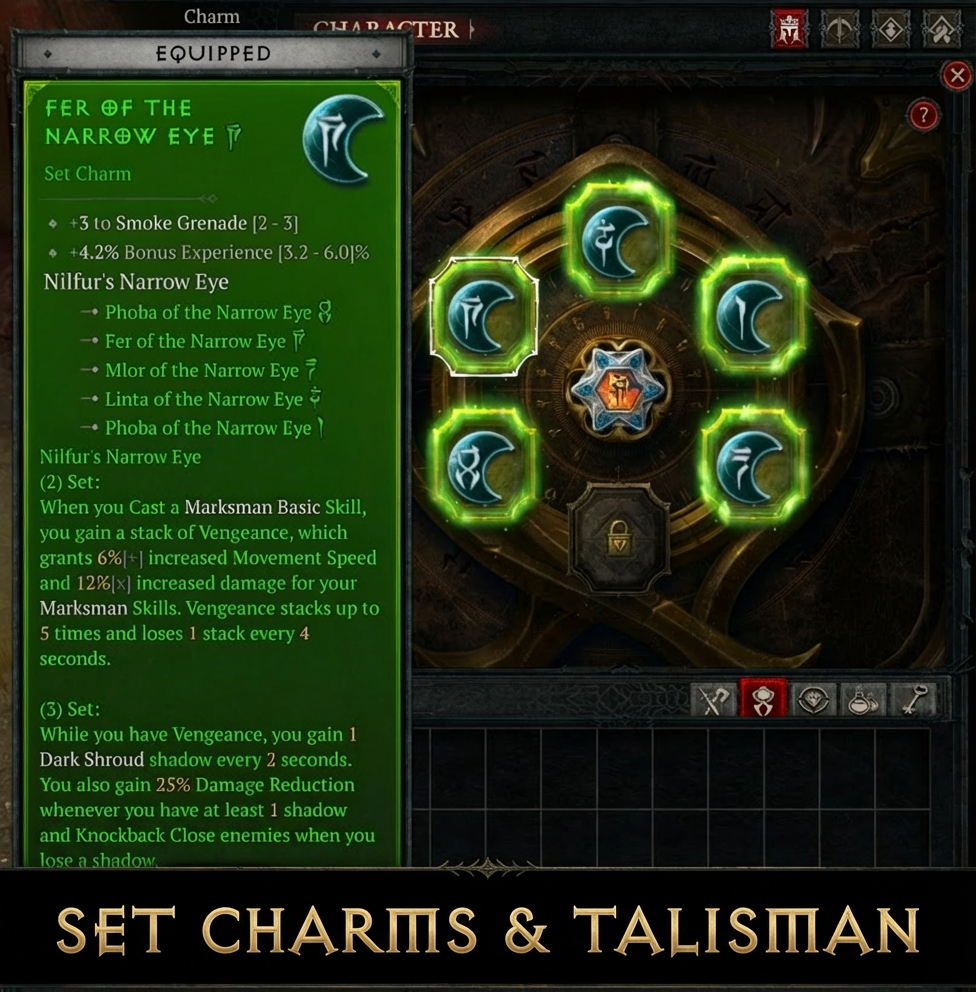
From the set charms shown, each one had two affix rolls. Typically, one was a skill rank increase and the other was a utility-type stat, things like experience bonuses, crafting material drop increases, or resistance boosts. No charms shown so far have had two offensive rolls, though it's possible they exist and just haven't been revealed.
Charms Are World Drops
These are actual items that drop while you're farming content in the world. They're not quest rewards or currency purchases. This means they become another category of loot to chase, and players will be hunting for the best-rolled versions of the charms they need.
How To Get Talisman Items?
The Talisman system becomes available once you reach the endgame in Lord of Hatred. Upon equipping the Talisman itself, charms will begin dropping as loot in the world. Seals and set charms are standard drops, meaning you'll find them while running dungeons, fighting bosses, and farming open-world content.
The Horadric Cube will also play a role through crafting recipes, including converting unique items into unique charms and re-rolling set charm affixes. This gives players both a passive farming path and active crafting options to work toward their ideal Talisman setup.
Diablo 4 Set Items in Lord of Hatred
Set items in Diablo 4 are charm-based. You collect individual set charm pieces and slot them into your Talisman's outer sockets to activate tiered set bonuses, similar in concept to Diablo 3's set system, but without occupying any of your normal gear slots.
Set Bonuses Are Tiered at 2, 3, and 4 Pieces
The sets revealed so far have bonus thresholds at the two-piece, three-piece, and five-piece levels. Since you can have a maximum of six charm sockets (depending on your seal), you could run a full five-piece set and one extra charm, or split your sockets between a three-piece and a two-piece from different sets, or go with a three-piece set plus two unique charms.
Sets Are Class-Specific
The class-specific sets shown so far always tie into particular skills or skill categories for that class. Generic sets that any class can use will also exist, but those appear to be limited to two-piece and three-piece bonuses with more basic stat increases.
Set Charms Can Be Re-Rolled
Through the Horadric Cube, there will be a crafting recipe to re-roll a set item. It's not yet clear if this re-rolls the entire charm (including which set it belongs to) or just the affixes on that set charm piece.
Diablo 4 Set Items & Set Bonuses for Each Class
Several sets have been teased or shown in detail so far. Here's what we know about each one:
Nilfur's Narrow Eye (Rogue)
This set item is built around marksman basic skills for the Rogue.
Set Charms:
Phoba of the Narrow Eye
Fer of the Narrow Eye
Mlor of the Narrow Eye
Linta of the Narrow Eye
Phoba of the Narrow Eye
Set Bonuses:
Two-piece bonus: When you cast a marksman basic skill, you gain a stack of Vengeance. Each stack grants 6% increased movement speed and 12% multiplicative damage for marksman skills. Vengeance stacks up to five times and loses one stack every 4 seconds. At full stacks, that's a 60% multiplicative damage boost — strong, but not the absurd thousands-of-percent increases that defined Diablo 3.
Three-piece bonus: While you have Vengeance, you gain one Dark Shroud shadow every 2 seconds. You also gain 25% damage reduction when you have at least one shadow, and you knock back nearby enemies when a shadow is lost. This creates a passive defensive loop that ties directly into the Dark Shroud skill and its upgrade paths.
Five-piece bonus (speculated): Not officially confirmed, but based on developer teases, it may be the auto-cast effect described below.
Rogue Auto-Cast Marksman Set
One of the teased rogue sets causes any marksman basic skill on your bar to auto-cast when enemies get close. Many players and content creators believe this is the five-piece bonus of the Narrow Eye set, since it synergizes perfectly with the Vengeance stacking and Dark Shroud generation from the two- and three-piece bonuses. If true, this would let you passively build stacks, gain movement speed, generate shadows, and deal damage just by running near enemies.
Rogue Shadow Clone Set
Another rogue set gives you a permanent shadow clone that cycles through casting your equipped ultimate-tier skills. With the expansion's skill tree rework allowing full 12-point investment into ultimate-tier abilities (with the same upgrade and variant paths as every other skill), a fully specialized ultimate being cast repeatedly by a shadow clone could be extremely powerful.
Druid Werebear Companions Set
A druid set has been teased that grants two werebear companions. Based on the description, these appear to be separate from your existing companion skills, meaning you could still run wolves, ravens, and poison creeper vines while also having werebear allies. This has the community already anticipating full "zoo builds" for the Druid class in the expansion.
Can You Turn Unique Items Into Unique Charms?
Yes, and this might be one of the most build-warping features of the entire Talisman system.
How to Convert Uniques To Unique Charms?
Through the Horadric Cube, you'll be able to take any unique piece of gear: a weapon, helmet, amulet, or anything else, and convert it into a unique charm. The process will likely require rare crafting materials alongside the unique item itself.
What Transfers to the Charm Version?
The specifics haven't been fully confirmed, but the primary purpose appears to be preserving the unique effect of that item in charm form. It's still unclear if the charm version will retain all of the original item's affixes, just one or two, or none at all. Most speculation leans toward the charm keeping the unique power and maybe a couple of affixes at most.
Why This Matters for Builds
The real value here is freeing up a gear slot. If a build currently requires a specific unique weapon to function, converting that weapon into a charm means you can now equip a completely different weapon, or even dual-wield, use a mythic item in that slot, or stack additional legendary aspects you couldn't previously fit.
With the Horadric Seal of Honor allowing two unique charms, you could theoretically move two uniques off your gear and into your Talisman. That opens two gear slots for entirely new items, which could lead to build configurations that were never possible before.
Will Diablo 4 Sets Be Overpowered Like in Diablo 3?
This is one of the biggest concerns in the community, and the developers seem very aware of it.
Diablo 3's Set Problem
In Diablo 3, sets became so dominant that nearly every viable endgame build revolved around a six-piece set bonus. Many of those bonuses granted damage multipliers in the range of 10,000% or more, which made non-set builds almost unplayable by comparison. Blizzard eventually had to introduce the Legacy of Dreams gem just to give players a way to opt out of sets entirely — a design band-aid that spoke volumes about how warped the system had become.
Diablo 4's Approach Is Different
Based on everything shown so far, Diablo 4's set bonuses are deliberately more restrained in raw numbers. The Narrow Eye's maximum damage boost at full stacks is 60% multiplicative, meaningful, but not game-breaking compared to other sources of damage in the current meta.
More importantly, the design focus seems to be on gameplay changes rather than pure stat inflation. Sets that auto-cast skills, spawn companions, or create permanent shadow clones are changing how you play, not just how big your numbers get. This approach also avoids the problem of sets competing against your equipped gear, since they occupy a completely separate system.
Some players are thrilled to have a set chase again. Others worry this will eventually creep toward the same power inflation problems Diablo 3 had. A few community members have pointed out that the system has echoes of Diablo Immortal's charm mechanics or World of Warcraft's rotating borrowed-power systems. The consensus seems cautiously optimistic, but players are watching closely to see how the power curve develops post-launch.
Are There Generic (Non-Class) Sets?
Yes. In addition to class-specific sets, there will be generic charm sets usable by any class. However, these appear to be limited to two-piece and three-piece bonuses only - no five-piece generic sets have been mentioned.
The bonuses on these generic sets are expected to be more straightforward: base stat increases, general defensive buffs, or other broadly applicable effects. The class-specific sets and unique charms will likely remain the primary focus for most optimized builds.
The Talisman system represents Diablo 4's attempt to bring back the fantasy of collecting and completing item sets without repeating the mistakes of Diablo 3. By housing sets in their own separate system, one that doesn't compete with your armor, weapons, or jewelry, the developers have created space for powerful and creative bonuses that change how builds play rather than just how much damage they deal.
Between seals that control your socket layout, set charms that alter your skill interactions, and the ability to convert unique gear into charms, the Talisman adds a substantial new dimension to endgame build crafting. How well it all holds together will depend on tuning and how many sets arrive at launch, but the foundation looks promising for players who've been waiting for this kind of itemization depth in Diablo 4.