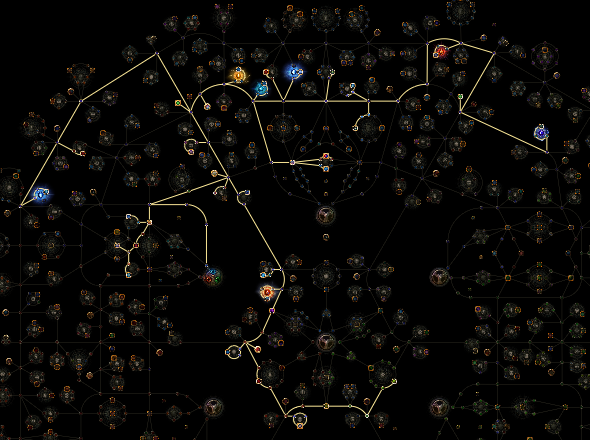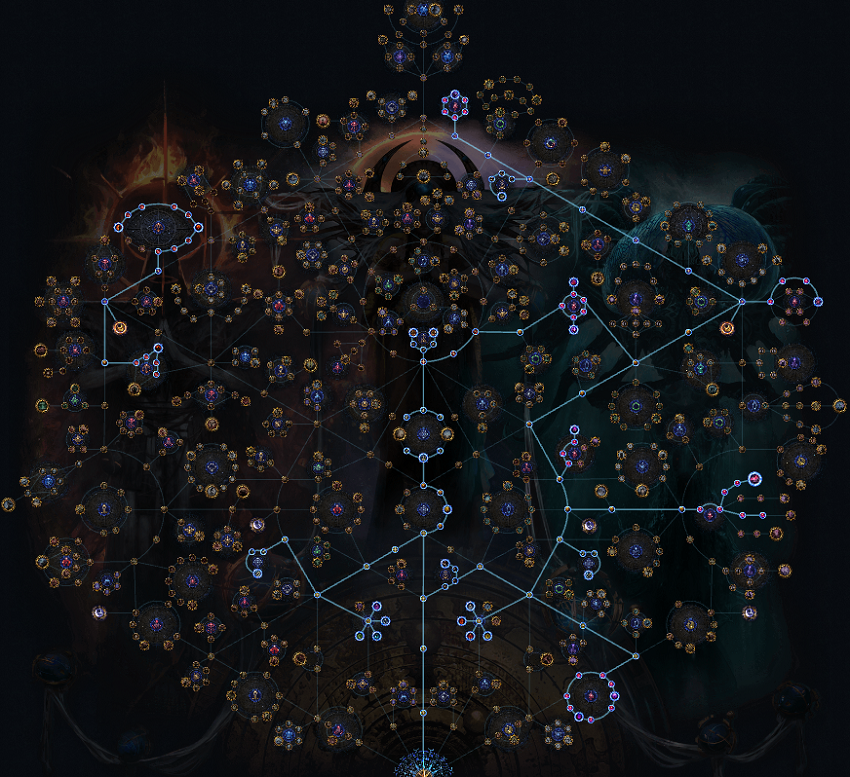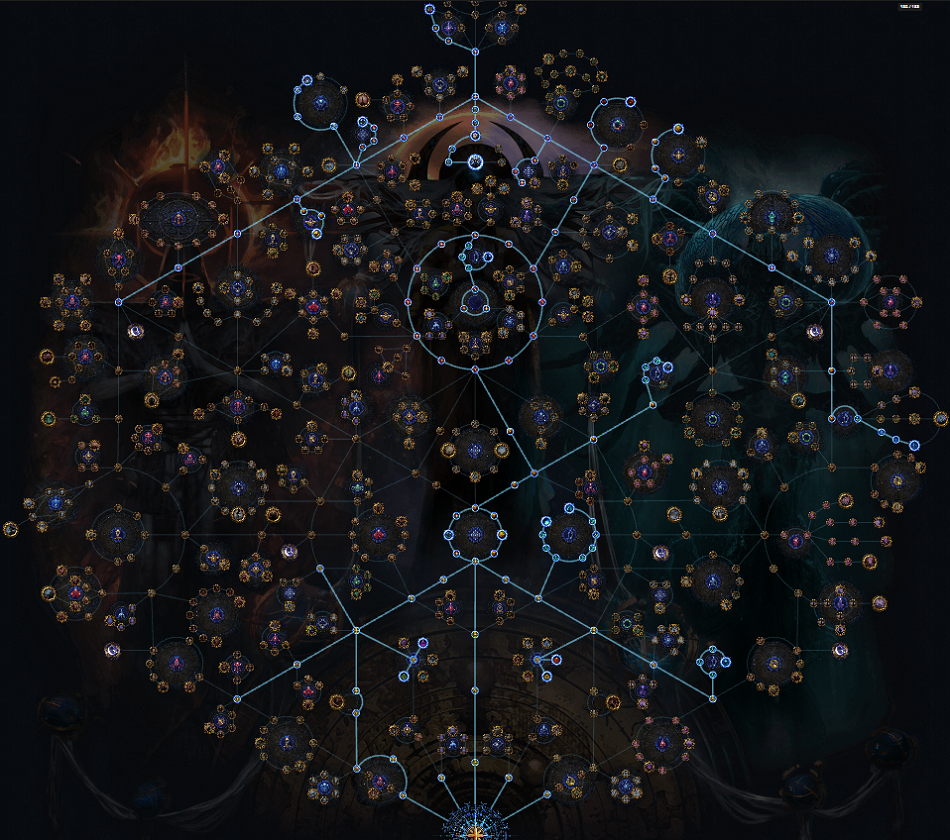



The Genesis Tree was introduced in Path of Exile 3.27 (Keepers of the Flame) and has transitioned into a permanent core mechanic in 3.28 Mirage league. While the system still allows you to grow currency in PoE 3.28, rare equipment, unique items, and mysterious rewards from Wombgifts, GGG has rebalanced it considerably for its role as a core league feature. Grafts have been removed entirely, Graftblood has been renamed to Hiveblood, and several passives have been adjusted. This guide covers how the Genesis Tree works in 3.28, how to earn points efficiently, and the best tree setups for profit crafting, 6-links, unique farming, jewel crafting, and resistance gear.
What Changed in PoE 3.28 for the Genesis Tree?
Before jumping into strategies, it is important to know exactly what has changed from 3.27 to 3.28, since several of the old approaches no longer apply or need to be adapted.
The Genesis Tree is now fully grown by default, meaning all four wombs (Equipment, Currency, Unique, Mysterious) are accessible from the start. However, you still need to work with Ailith and complete specific objectives to earn passive points for each branch. Graftblood has been renamed to Hiveblood, and it no longer requires Grafts to store. Instead, Hiveblood is stored automatically with a maximum capacity of 100,000 and is shared across all characters within a league.
Grafts can no longer be grown from the Genesis Tree - the entire Graft branch has been pruned. The Graft Locker has been renamed to the Wombgift Locker. Growing Wombgifts, which were a cheap way to generate massive quantities of items in 3.27, have been removed from the game entirely. Provisioning Wombgifts can no longer produce Weapon or Quiver items, limiting the Equipment womb to armour, jewellery, and jewels only.
The total number of passive points available in each Genesis Tree subtree has been reduced. Several passives have been rebalanced—most notably, Modifier Tier Rating granted to rare items has been lowered, and there is now more variance in the Item Level of items generated from Equipment Wombs. Most sources of guaranteed additional Item Levels have been removed, so you will see more fluctuation in the gear you produce.
A key difference from 3.27 is that Breach no longer appears in every single map by default. In 3.28, Breach encounters start appearing around Act 6 during the campaign, and in maps you will need to invest Atlas passive points into the Breach cluster or use Breach scarabs to guarantee encounters. This means your access to Hiveblood and Wombgifts will be more limited unless you actively spec into the mechanic on your Atlas tree.
The "Growing Wombgift Chance" passive in the Mysterious tree has also been removed in version 3.28.0.
How the Genesis Tree Works in PoE 3.28?
The Genesis Tree is an interactable object located in the Monastery of the Keepers. When you interact with it, a passive tree opens that allows you to customize rewards from four different womb types. Each womb corresponds to a sub-tree with its own pool of passive points.
Defeating Hiveborn monsters in Breach Hives, Unstable Breaches, and Hive Fortresses grants Hiveblood, which is stored automatically up to the 100,000 cap. When you visit the Genesis Tree, you insert Wombgifts into the appropriate womb slots, and the tree consumes Hiveblood to "birth" rewards. The type and quality of rewards depend on which passives you have allocated in that womb's sub-tree.
There are four types of Wombgifts in 3.28, each corresponding to a womb:
Provisioning Wombgift feeds the Equipment item womb and grows into rare armour, jewellery, or jewels (no longer weapons or quivers).
Lavish Wombgift feeds the Currency item womb and grows into currency items, with optional chances for Foulborn currency, gold, shards, and implants.
Ancient Wombgift feeds the Unique item womb and grows into unique items, including Foulborn unique variants.
Mysterious Wombgift feeds the Mysterious item womb and can produce Stacked Decks, high-level gems, specific divination cards, Shaper Guardian / Elder Guardian / Conqueror / Synthesis maps, scarabs, and Hivebrain Glands.
Each womb itself costs 1 passive point to activate. You can insert Wombgifts manually or click the slot to see a list of applicable Wombgifts from your inventory or Wombgift Locker. Pressing CTRL + Left Click on a Wombgift (either in the list or when it is already inserted) will cause it to birth instantly, provided you have enough Hiveblood.
One of the most powerful features of this system is that passives on the Genesis Tree can be freely refunded and reallocated at no cost. This lets you constantly adjust your tree to match your current needs, switching between farming currency, crafting specific rare gear, or rolling for uniques without any penalty.
How to Earn Hiveblood and Genesis Tree Points in 3.28?
How To Get Hiveblood:
Hiveblood is earned by completing Breach encounters in maps. The amount gained depends on the area level and the type of encounter, not on item quantity or how many monsters you kill. Higher area levels and more complex encounter types (such as Hive Fortresses) yield more Hiveblood per run.
Since Breach is no longer forced into every map, you will want to spec your Atlas tree into the Breach cluster and supplement with Breach scarabs if you want consistent Hiveblood income. Without investment, Breach will appear sporadically, and your Hiveblood generation will be limited.
For Unstable Breaches, make sure to reveal all portals (indicated by gray and pink dots on the minimap) before they close. Walking over these dots signals monster spawns from those points, and the more you activate, the more Hiveblood you collect.
For Hive Fortress encounters, full-clearing the entire fortress—including opening all purple chests—before starting the wave fight is the most rewarding approach. These encounters produce the most Hiveblood per run.
How To Get Genesis Tree Points:
Passive points for each Genesis Tree sub-tree are earned independently through two methods: gifting Hiveborn body parts to the tree and gifting cumulative amounts of Hiveblood.
Body parts are quest-like items that drop as green-highlighted quest items from various Breach encounters. Based on community reports for 3.28, these drop from completing different types of Breach content:
Completing a Breach Hive or Unstable Breach for the first time awards the Horned Skull. Further body parts: Handmouth, Clasped Skull, Claw Bramble, Severed Limb, Strange Limb, and Foul Hand, drop from completing Hives and Unstable Breaches at various progression stages. The Head of Vruun drops from killing Vruun in a Stabilized Breach, the Spiked Limb from completing a Hive Fortress, and Breachlord Limbs from killing It That Was Tul and It That Was Esh in a Hive Colony.
Additional points are earned by simply spending Hiveblood at the tree. As you consume more Hiveblood over time, you will hit cumulative thresholds (300, and further amounts up to very high totals) that award more points for each sub-tree.
All body part drops in 3.28 can be completed entirely in maps—there is no need to return to the campaign. Players who skipped Breach during leveling can catch up once they start running maps with Breach enabled on their Atlas. The progression is largely automatic: if you are running Breaches regularly, you will pick up the body parts and spend enough Hiveblood to earn all your points without any special planning.
How to Craft with the Genesis Tree in PoE 3.28?
The Equipment womb on the Genesis Tree gives you a remarkable degree of control over the rare items you produce. By allocating passives strategically, you can steer the item type, attribute requirements, and modifier weighting of birthed equipment.
Selecting Item and Base Types
The tree offers nodes that massively increase the chance for a birthed item to be a specific slot: body armour, helmet, boots, gloves, shield, belt, ring, amulet, or jewel. These nodes carry very high multipliers (5000% increased chance for specific slots like Body Armour, Boots, Helmets, etc.), so when you allocate one, the vast majority of items from that womb will be the chosen type.
You can also guide the base type by manipulating attribute requirements. Nodes like "More Intelligence Items" (300% more chance for Intelligence requirements) push results toward energy shield bases, while "More Strength Items" pushes toward armour bases, and "More Dexterity Items" toward evasion. Conversely, "Less" attribute nodes (75% less chance) can be used to exclude base types you do not want. Combining "More Intelligence" with "Less Strength" and "Less Dexterity" will heavily favor pure energy shield bases, for example. For hybrid bases like energy shield and evasion, you would allocate both "More Intelligence" and "More Dexterity" while reducing Strength.
Note that in 3.28, Provisioning Wombgifts can no longer produce weapons or quivers. If you want rare weapons, you will need to use other crafting methods like Rog, Harvest, or bench crafting.
Influencing Modifiers
The Equipment tree contains two categories of modifier manipulation: "Devoted" notables that increase the chance for specific modifier tags, and "Forsaken" notables that reduce the chance for specific tags.
The Devoted side includes notables like Devoted Technique (which gates access to nodes increasing the chance for Chaos, Physical, Fire, Cold, and Lightning modifiers at 400% increased), Devoted Zeal (gating Critical, Attack, Caster, and Speed modifiers at 1000% increased), and Devoted Soul (gating Life, Mana, Defense, Attributes, and Resistance modifiers at 1000% increased).
The Forsaken side works in reverse: Forsaken Technique reduces chances for elemental and physical/chaos modifiers by 80%, Forsaken Zeal reduces Speed, Caster, Attack, and Critical by 80%, and Forsaken Soul reduces Defense, Attributes, Resistance, Mana, and Life by 80%.
By combining increased and reduced modifier chances, you can dramatically shift the modifier pool. For example, if you want boots with life, resistances, and movement speed, you would increase Life, Resistance, and Speed modifiers while reducing unwanted tags like Mana, Attack, Caster, and Critical. Each modifier on an item has associated tags (visible by holding Alt while hovering), and the tree's weighting system multiplies or diminishes the roll chance for all modifiers sharing those tags.
Using Mod Pools and Weight to Your Advantage
Every item base has a pool of possible modifiers, each with a roll weight. Tools like Craft of Exile and PoE DB let you inspect these pools. When a node multiplies the weight of a tag—say, increasing Fire modifiers by 400%—you improve the odds of rolling fire-related mods relative to everything else. If you have also reduced competing tags, the effect compounds dramatically.
For instance, a belt's modifier pool might total 51,000 in combined weight. A tier three life mod with a base weight of 1,000 has roughly a 1-in-51 chance to appear normally. But if you increase Life modifier chance by 1000% (via Devoted Soul and the Life node) and reduce several other tags by 80% each, that life mod's effective weight rises relative to the shrinking pool, and your odds improve substantially.
Step-by-Step Example: Crafting a Resistance Belt
To produce a belt with high resistances and life, allocate the Increased Belts Chance node (5000%) to force belt production. Then path through Forsaken Soul or Forsaken Zeal to reduce unwanted tags—Attack, Mana, Caster, Critical—by 80% each. Next, allocate the Increased Resistance Modifier Chance and Increased Life Modifier Chance nodes from Devoted Soul. With this setup, the vast majority of your birthed belts will roll with multiple resistance and life affixes.
PoE 3.28 Best Genesis Tree Setups & Breach Crafting Strats
Since passive points have been reduced in 3.28, you will need to be more deliberate about your pathing. The ability to freely respec means you can switch between setups at will, but you will not be able to grab every powerful node simultaneously.
Currency Genesis Tree Setup (Farming Divines and Valuable Currency)
The Currency sub-tree remains one of the most popular for profit. The core strategy is to stack nodes that add extra currency items per Wombgift while avoiding nodes that convert currency into less desirable forms.
Recommended path: Allocate both small Additional Currency Chance nodes (50% chance each for an additional currency item). Path toward Wild Growth (2% chance for birthed currency to drop as a full stack)—this is the single most valuable node for profit, as it can turn a single Chaos Orb into a full stack or, rarely, produce a stack of Divines. Pick up Prodigal Offspring (25% chance for 3 additional currency items, 3% chance for 10 additional) and Fertile Genesis (birthed currency rolled an additional time, keeping the rarest outcome) to further improve both quantity and quality.
Nodes to avoid: Reflexive Contractions converts currency into random shards, which is almost always a downgrade since Divine Orbs have no shard form. Encrusted Fruit converts 25% of currency into Gold, which is generally less valuable than direct currency drops. Skip these unless you have a specific reason.
Foulborn Currency consideration: Flawed Seeds and Mutation Cultivation add chances for Foulborn Currency, which can be valuable depending on the 3.28 meta. If Foulborn currency items are selling well, investing points into these nodes can be worthwhile, but in most cases the baseline currency strategy produces more consistent returns.
Rare Item Genesis Tree Setup (6-Links and High-End Rares)
Producing 6-linked rare items has been one of the most powerful applications of the Genesis Tree, and while the rebalancing in 3.28 has reduced some of the tree's raw power, the core approach remains effective.
Recommended path for 6-links: Allocate the small Socket and Link Count node (+10 rerolls) early, then path toward Arterial Mesh (+150 socket/link rerolls, keeping the best outcome). This node is what enables consistent 5- and 6-link production. Combined, your birthed armour will roll sockets and links 160+ times and keep the best result—this alone can save you hundreds of Fusings per item. Pair this with Guardian Flesh (400% increased chance for armour) and the Increased Body Armour Chance node (5000%) to target body armours specifically.
Modifier optimization: Add Modifier Tier Rating nodes (+25 and +50) to push modifier rolls toward higher tiers. Allocate Severing (lowest level modifier removed) to clean up results. Use the Forsaken and Devoted paths to reduce unwanted modifier tags and increase the ones you care about.
Attribute targeting: For trade value, hybrid Dexterity/Intelligence bases (evasion/energy shield) tend to sell well. Allocate "More Dexterity Items" and "More Intelligence Items" while taking "Less Strength Items" to steer toward these bases.
Fractured items: If the Solid Cysts node (33% chance for birthed equipment to be Fractured) is still accessible with your available points, it can add enormous value. A fractured item with a desirable locked affix becomes a premium crafting base worth many Divines.
Note for 3.28: Since Provisioning Wombgifts can no longer produce weapons or quivers, this setup is limited to armour pieces and jewellery. The 6-link strategy applies specifically to body armours.
Unique Item Genesis Tree Setup (Farming Mageblood, Headhunter, and Foulborn Uniques)
When targeting high-value unique items, the Unique tree offers nodes that increase the chance for Foulborn variants, reroll for rarity, and focus on specific item slots.
Recommended path for chase uniques: Allocate Recessive Genes (birthed uniques rolled an additional time, keeping the rarest outcome). This node heavily biases results toward T4 and T3 uniques, which include chase items like Mageblood and Headhunter. In Keepers league, the Unique tree produced roughly 1.25 uniques per Wombgift at baseline, and with Foulborn Gluttony allocated, this rose to about 1.75.
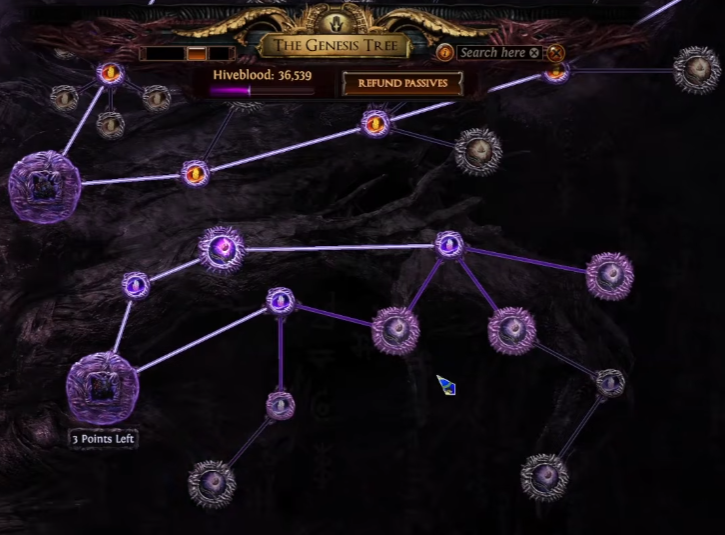
PoE 3.28 Genesis Tree for Mageblood
Foulborn strategy: If you want Foulborn unique variants, path toward Corrupted Flesh (100% increased chance to be Foulborn, non-Foulborn items are Corrupted), and pick up small Foulborn Chance nodes along the way (each adds 15% increased chance). Extremely Foul gives a 20% chance for multiple Foulborn modifiers on Foulborn uniques. However, if you are targeting specific non-Foulborn chase uniques, avoid Corrupted Flesh entirely—it will corrupt all non-Foulborn results, which can brick socket colors and links.
Slot targeting: Body armours and belts are popular targets because many high-value uniques sit in these slots. Allocate Guardian Lineage (100% increased chance for armour) with Increased Body Armour Chance (1000%) or the belt-specific node. Throbbing Veins (+150 socket/link rerolls on unique weapons and armour) is valuable if you are targeting armour uniques, as well-linked Foulborn body armours sell for premium prices.
Breach-Specific uniques: Foulborn Ancestry (100% increased chance for Breach Specific, 30% increased Foulborn chance) and Remembered Origins (300% increased Breach Specific, but 100% reduced Foulborn chance) let you target Breach-specific uniques. Choose based on whether you want Foulborn variants or clean versions.
Jewel Crafting Genesis Tree Setup
Jewels remain one of the most cost-effective targets for Genesis Tree crafting because all possible jewel modifiers can appear starting at item level one. This means low-level Wombgifts, which cost very little Hiveblood, work just as well as high-level ones for jewel production.
Recommended path: Allocate the Increased Jewel Chance node (5000% increased chance, also causes Provisioning Wombgifts to birth jewels instead of armour/jewellery). Path toward Solid Cysts (33% chance to be Fractured) since a fractured jewel with a strong affix like life or crit multiplier can be extremely valuable. Add modifier manipulation nodes to favor the stats your build or the market demands—for example, increasing Critical modifier chance and reducing Mana, Defense, and Attribute modifiers for a crit-focused jewel.
Crafting process: Because low-level Wombgifts consume minimal Hiveblood, you can spam large batches of jewels quickly. Most will be mediocre, but jewels with combinations like crit multiplier for lightning skills, global crit chance, and crit chance with elemental attacks can sell for a Divine or more. Fractured jewels with a strong locked mod add further value.
Resistance Crafting Genesis Tree Setup (Fire, Cold, Lightning)
One of the most practical early-league applications of the Genesis Tree is producing gear that caps your elemental resistances. This approach works well in both trade and SSF, and the tree's free respec mechanic lets you switch between item slots rapidly.
Boot example: Allocate Increased Boots Chance (5000%), then path through Devoted Soul to increase Resistance Modifier Chance (1000%) and through Devoted Zeal to increase Speed Modifier Chance (1000%)—this targets both resistances and movement speed. Reduce unwanted tags like Attack, Caster, Critical, and Mana through the Forsaken notables. The result is boots with high odds of rolling multiple resistances and movement speed.
Ring example: Shift to Increased Rings Chance (5000%), keep Resistance Modifier Chance active, and block Attack and Physical tags through the Forsaken path. Reference PoE DB to see which mods on rings carry the highest base weight in the tags you are blocking, ensuring you are removing the most probable "junk" modifiers from the pool.
Flexibility: Because respeccing costs nothing, you can craft resistance boots in one session, then respec to rings, then to gloves—all in a few minutes. This is one of the most time-efficient ways to fill resistance gaps on your character, and it does not require expensive bases or stacks of Chaos Orbs.
Mysterious Genesis Tree Setup
The Mysterious sub-tree produces a variety of rewards including Stacked Decks, high-quality gems, divination cards, special maps, scarabs, and Hivebrain Glands. In 3.28, the "Growing Wombgift Chance" node has been removed, so the sub-tree is somewhat smaller.
Recommended path: Allocate Parthenogenesis (Mysterious Wombgifts may birth other Wombgifts), which gives you a chance to generate additional Wombgifts—effectively turning one Mysterious Wombgift into multiple rewards of different types. Then choose the specific womb type chance node that benefits you most: Lavish Wombgift Chance (800% increased) if you want more currency Wombgifts, Ancient Wombgift Chance (800%) if you want more unique Wombgifts, or Provisioning Wombgift Chance (800%) if you want more equipment crafts.
Natural Selection (100% chance for an additional item, 25% increased chance for commonly found items) is a solid pickup for raw item quantity. Artificial Selection (50% increased chance for infrequently found items) is useful if you are targeting Hivebrain Glands or rarer drops from the Mysterious pool, though community testing on this node is still ongoing.
Tips for Maximizing the Genesis Tree in PoE 3.28
Since Breach is no longer guaranteed in every map, you will want to invest Atlas passive points into the Breach cluster early if you plan to rely on the Genesis Tree for progression. Breach scarabs can supplement this, but they cost currency, so weigh the investment against your expected returns.
Hiveblood is capped at 100,000 and shared across all characters in a league. If you are approaching the cap without spending, pop some Wombgifts to avoid wasting Hiveblood. Players in 3.28 have reported that spending Hiveblood also contributes to earning additional Genesis Tree points at cumulative thresholds, so regular spending has a double benefit.
The removal of Growing Wombgifts means you are limited to the four standard Wombgift types that drop from Breach encounters. This reduces the raw volume of items you can produce compared to 3.27, but the quality of each individual craft is still high. Focus your Wombgifts on whichever sub-tree gives you the best return for your current situation rather than spreading them thin.
For SSF players, the Genesis Tree remains one of the best tools for bridging gear gaps between the campaign and red maps. Even with reduced point totals and lower Modifier Tier Rating, the ability to target specific item slots and modifier tags far outperforms random drops. A well-configured Equipment tree can produce usable 5-linked body armour with decent stats long before you would naturally find or craft one through other means.
For trade league players focused on profit, the Currency and Unique trees are typically the highest-value options once your character is geared. Currency Wombgifts with the full-stack and additional-item nodes generate steady income, while Ancient Wombgifts with Recessive Genes and slot-targeting nodes give you repeated shots at chase uniques. Body armour Foulborn uniques with good links remain a consistent seller.
Finally, always check the current market before committing to a tree setup. Foulborn unique values, 6-link prices, and jewel demand fluctuate throughout a league. The Genesis Tree's free respec system means you can pivot your entire strategy in seconds—use that flexibility to follow the market.