



Hunting for rare blueprints and high-value loot in ARC Raiders often comes down to knowing where to look. Caches are scattered across every map, but not all of them offer the same rewards — and not all of them spawn under the same conditions. This guide maps out every cache type, where to find them, what they drop, and how to farm them efficiently.
ARC Raiders Cache Locations & Farming Guide (Flashpoint Update)
ARC Raiders features two distinct cache types that share similar spawn points but differ drastically in loot quality and availability. Hurricane Caches (officially called First Wave Caches) only appear during the hurricane map condition and contain some of the rarest blueprints and gear in ARC Raiders. Raider Caches are the standard variant — they spawn on every raid regardless of weather and hold more common items like basic weapons, ammo, and supplies. Both emit audible sounds that help you track them down, and both tend to appear in overlapping locations on the map. Learning where one spawns often means learning where the other does too. Below is a full breakdown of each type, organized by map, loot pool, and the best approach to farming them.
ARC Raiders Hurricane Cache Locations, Loots & Best Farming Route
Hurricane Caches, referred to as "First Wave Caches" in-game, were introduced with the Shrouded Sky update. They only appear when the hurricane map condition is active. These caches replaced the regular raider caches during the event, meaning you won't find normal raider caches and hurricane caches side by side in the same raid.
They emit a distinct sound compared to regular caches. Instead of the usual mechanical ticking, hurricane caches produce a rhythmic electric hum with a buzzing quality. Many players describe it as sounding like a faint alarm clock or a security camera loop. The sound is harder to pick up during the hurricane due to wind noise, so headphones are strongly recommended.
Where Hurricane Caches Spawn
Hurricane caches use the same general spawn pool as regular raider caches. However, only a random subset of those locations will actually have a cache in any given raid. Expect roughly 1 out of every 5 to 10 possible markers to contain one. No spawn is guaranteed; community-sourced maps from Metaforge and ARC Raiders Hub show where caches can appear, not where they will appear every time.
Hurricane caches do not spawn on Stella Montis, since it is an indoor map that does not support the hurricane condition.
How to Hear Hurricane Caches
Hurricane Caches produce a rhythmic electric hum — distinctly different from the mechanical ticking of regular raider caches. Many players describe it as sounding like a buzzing alarm clock or a security camera loop.
The Hurricane Wind Problem
The hurricane wind noise drowns out the cache sound for many players. Community reports confirm that the audio radius is small, meaning you might walk within 15 meters of a cache and never hear it. Several Reddit users have noted they can only detect caches when standing nearly on top of them.
Audio Settings That Help
Switching your audio output from "System Default" to "Stereo" in the sound settings has fixed detection issues for multiple players. Turning on night mode in the audio menu, disabling all music, and setting game sound to 100% also improves your ability to pick up the cache hum over wind noise. Good headphones with noise isolation are strongly recommended.
Audio Hunting Technique
When you approach a known spawn zone, stop moving entirely. Listen for 3–5 seconds. If the buzzing repeats in a steady pattern, a cache is nearby. Turn slowly left and right to pinpoint the direction where the sound is loudest, then close the distance.
ARC Raiders Hurricane Cache Locations by Map
Hurricane caches appear on all maps except Stella Montis, which is an indoor environment that doesn't support the hurricane condition. Community-sourced maps on Metaforge and ARC Raiders Hub show all possible spawn locations. Below is a map-by-map guide to the best farming routes.
Dam Battlegrounds Hurricane Cache Locations & Farming Route
Dam Battlegrounds has the highest density of cache spawn points among all maps. The open terrain allows fast travel between clusters, and there are multiple extraction options including hatch keys. Several players report consistently hitting 3–5 caches per run on this map.
Key Spawn Areas
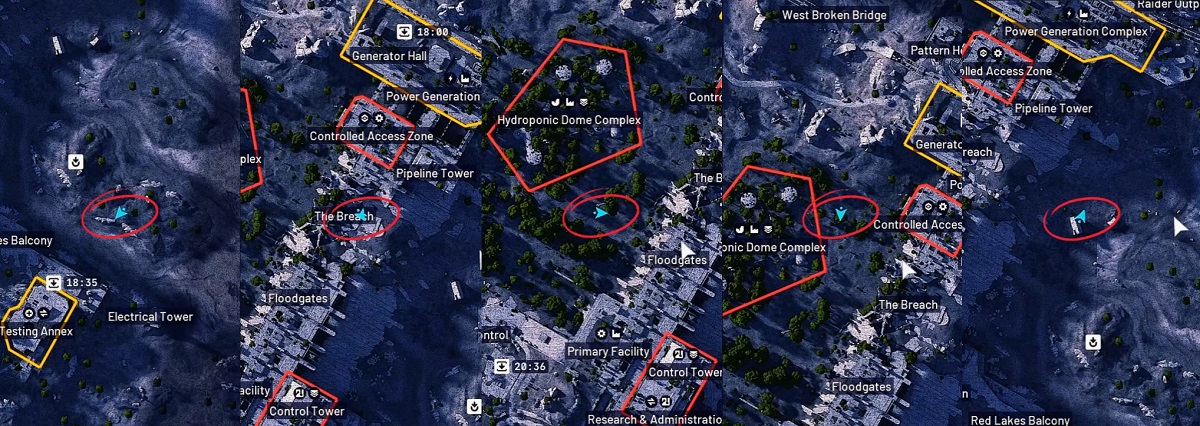
Cache spawn zones are spread across the Testing Annex, Red Lakes, Formakai Hills, Research and Admin, Water Treatment Control, Scrapyard, Old Battleground, the Hydroponic Dome Complex, the Power Generation Complex, and several highway and bridge areas.
 Best Farming Route
The map lends itself to a sector-based approach. Start from whichever cluster is closest to your spawn point.
If you spawn near the southeast, work through the Red Lakes balcony, Testing Annex forest, Formakai Hills, and the electrical substation area before moving northwest toward the water towers and Water Treatment Control.
If you spawn near the south or southwest, begin at the South Swamp Outpost area, sweep through Water Treatment Control, up to the Hydroponic Dome Complex, and then across toward Old Battleground.
If you spawn near the west or northwest, start at the Pale Apartments or Ruby Residence area, pass through Victory Ridge, check the west side of the Power Generation Complex (this area frequently holds two caches very close together), and continue toward the West Broken Bridge.
If you spawn in the north, begin near the Pattern House by the Power Generation Complex, check the hills to the east, move through the bridge camp area, and work down toward Pipeline Tower and the dam breach before ending in the Red Lakes.
Each sector naturally feeds into the next. After clearing the closest one, transition to the adjacent area. Wind direction matters, always plan your route to run with the wind or at an angle rather than directly into it. Running against the wind burns adrenaline shots fast and slows you down enough for other raiders to grab caches ahead of you.
Blue Gate Hurricane Cache Locations & Farming Route
Blue Gate is the community favorite for hurricane cache runs. Reddit users and social media feedback consistently rank Blue Gate as the most reliable map for finding unopened hurricane caches. The spawn clusters are well-distributed, extraction points are easy to reach, and the overall cache-finding success rate tends to be higher here than on other maps. The map layout offers multiple clusters within short travel distances, and extraction points are well-positioned along common routes.
Key Spawn Areas
Spawn zones are located around Gate Approach, Pilgrim's Peak, the highway collapse area, the Ancient Fort, the village, Raider's Refuge, Rapper's Glade, the ventilation shafts, and the Adon Wreckage.
Best Farming Route
Check your spawn position first. The southern portion of the map — near the village and Raider's Refuge, has tighter clusters that are efficient to sweep through quickly.
A proven route starts from the southern spawn areas, moves north through the highway collapse zone, swings past the Ancient Fort, and then continues through the central portions of the map toward the ventilation shafts and Rapper's Glade. Cache spawns near Pilgrim's Peak and the data vault edges are more spread out, so only check those if time allows.
The map has hatch extraction points along the route, so if you find a rare blueprint early, you can exit immediately without backtracking. One player reported finding Tempest, Bobcat, Vita Spray, and Explosive Mine blueprints all in a single Blue Gate run, pulling 141,000 credits total.
Running downwind feels noticeably faster on Blue Gate. If you spawn at the top of the map and the wind pushes south, take advantage of that momentum and save your adrenaline shots for the return trip.
Spaceport Hurricane Cache Locations & Farming Route
Spaceport has a decent spread of cache spawn points but is generally considered a step below Dam Battlegrounds and Blue Gate. The map is large, and the spawns are more spread out, which means more running between clusters. On the positive side, competition tends to be lower, fewer players choose Spaceport for cache farming, so you're more likely to find unopened caches.
Key Spawn Areas
Caches can appear near the Arrival Building, Departure Building, elevated platforms, trench hatches, and fuel processing zones.
Best Farming Route
Start from the spawn zone nearest to you and work through the closest cluster of marked locations. Spaceport's layout is less forgiving for long looping routes because the distances between clusters are larger.
Focus on a section of the map rather than trying to cover everything. After checking 4–5 spawn zones, begin moving toward a hatch exit. One player extracted from Spaceport with a Tempest blueprint, Vulcano blueprint, Explosive Mine blueprint, a Venador 4, and 152,000 credits in a single run, despite calling it "not the best map" for cache farming.
Bring a hatch key. The trench hatches on Spaceport are well-positioned for quick exits after you've swept a section.
Buried City Hurricane Cache Locations
Buried City is widely regarded as the most frustrating map for hurricane cache farming. Despite having cache markers on tools like Metaforge, players consistently report finding very few caches here. Multiple Reddit threads confirm that some runs produce zero caches across 15+ minutes of searching.
The vertical layout, dense buildings, and complex terrain all contribute to the problem. The cache audio is harder to hear in enclosed spaces, and the spawn density appears to be lower than other maps. After the Flashpoint update, several players noted that cache spawns felt even more reduced.
Key Spawn Areas
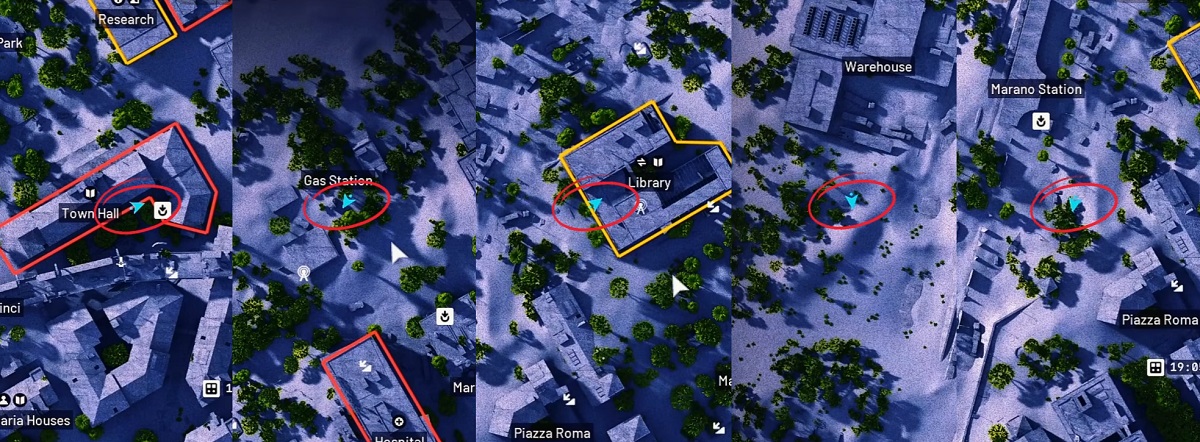
Known spawn zones include the Hospital, Town Hall, Space Travel area, and Plaza Rosa. Multiple players report finding the Canto blueprint specifically near the Plaza Rosa area, running from Town Hall to Plaza Rosa appears to be a productive short route.
Best Farming Route
Keep runs short and targeted. Rather than sweeping the entire map, pick a direction from your spawn and check 3–4 spawn zones. If nothing turns up within 5–8 minutes, exit and requeue.
The route from Town Hall to Plaza Rosa has been called out by multiple players as a hot spot for blueprint drops. One player spent four days hunting for the Canto blueprint and finally found it in Buried City near Plaza Rosa with only 30 seconds left on the hurricane timer. A second player confirmed finding their Canto at the same area.
If you must farm on Buried City, stick to the central areas where spawn zones are closer together. Avoid wandering to the map edges, the travel time between clusters is too long relative to the low spawn rate.
ARC Raiders Hurricane Cache Loots
Hurricane caches contain some of the most valuable items in ARC Raiders. The loot inside is dramatically better than what you'll find in regular raider caches.
Blueprints
This is the main draw. Hurricane caches can drop the following blueprints:
Tempest — appears more frequently than other purple blueprints based on community testing
Bobcat — purple-tier blueprint, previously limited to hidden bunker and locked gate conditions
Vulcano — another purple-tier blueprint that was formerly restricted to specific map conditions
Canto SMG — added to the loot pool in the Flashpoint update (Patch 1.22.0). Despite being blue rarity, it is currently the hardest to find because it was newly added
Vita Spray — a healing blueprint
Explosive Mine — a utility blueprint
Not every cache will contain a blueprint. Based on multiple player reports, roughly 50–60% of hurricane caches include one. Some runs produce multiple blueprint drops across several caches; others come up empty. Over multiple runs, most players accumulate blueprints steadily.
Weapons
Hurricane caches frequently drop high-tier weapons ready to equip or sell:
Renegade 4 (level 4 weapons are exceptionally rare from any other source)
Anvil 4
Tempest 4
Osprey 3
Torrente 3
Berlet 2, Arpeggio 2, and other mid-tier weapons
Finding a level 4 weapon in a cache is noteworthy — several players have reported never seeing a level 4 weapon drop from anything other than manual upgrading until they started farming hurricane caches.
Healing Items and Components
Beyond blueprints and weapons, hurricane caches regularly contain premium consumables and crafting materials:
Vitashots
Sterilized Bandages
Herbal Bandages
Defibrillators (often in stacks of 2–3)
Advanced Mechanical Components
Advanced Electronic Components
Exodus Modules
Magnetic Accelerators
Processors
Each cache typically has two full rows of loot, and rare items appear consistently.
Approximate Run Value
A single hurricane farming session of about an hour (across 4–6 raids) can yield 500,000+ credits in total value when factoring in blueprints, weapons, components, and healing items. Individual extractions often land between 120,000 and 160,000 credits.
ARC Raiders Hurricane Cache Best Farming Routes & Strategy
The Naked Run Method (Current Meta)
The most efficient strategy for blueprint farming right now is the naked run. Here is how it works:
Select the empty "naked" loadout. This loadout comes with a safe pocket, which is all you need.
Queue into a hurricane map. Prioritize Dam Battlegrounds or Blue Gate. Check the events page or a site like arcraiders hub.com beforehand — hurricane events rotate and are more sparse since the Flashpoint update.
Note your spawn location and immediately identify the nearest cache marker clusters on Metaforge or ARC Raiders Hub.
Sprint to the closest cluster. Listen for the electric hum as you approach each marker.
If you find a cache with a blueprint, place the blueprint in your safe pocket right away.
Surrender immediately (ESC → Surrender). The safe pocket item returns to Speranza with you.
Queue again. Repeat the process.
If you don't find a cache within 5–8 minutes, surrender and requeue. Post-Flashpoint spawn rates are lower, and lingering in a dry raid wastes time. This method lets you farm a blueprint every 2–5 minutes on a good streak, with zero risk since you carry nothing into the raid.
Why Naked Runs Work
You lose nothing when you surrender — no gear, no risk. You skip all PvP encounters entirely. Every new queue gives you a fresh set of randomized cache spawns. Blueprints stored in safe pockets always come home with you regardless of whether you extract, die, or surrender.
Traditional Farming (Off-Peak or Low Competition)
If you're playing during quieter hours and want to extract with a full inventory of loot, a traditional route-based approach still works:
Bring 10–15 Adrenaline Shots. Running against the hurricane wind drains stamina rapidly.
Remove your shield. Wearing a shield in the hurricane drains it constantly and makes you visible to other players.
Bring a hatch key. Hatches offer safe PvE extraction without needing to reach a standard extraction point.
Carry a reliable weapon like the Anvil or Ferro to handle Wasps, Hornets, and Fireflies. Avoid engaging larger ARCs like Rocketeers, Bombardiers, and Bastions if you're running without a shield.
Plan your route based on spawn location. Check the wind direction at spawn — running with the wind or at an angle saves stamina and time. Avoid running directly into the wind.
Move through clusters of markers rather than trying to hit every individual point on the map. If a cluster is dry, move to the next one.
On a good traditional run, you can collect 3–5 hurricane caches and extract with 140,000–160,000 credits worth of loot, multiple blueprints, high-tier weapons, and stacks of rare components.
The Survivor Augment Advantage
If you have the Survivor augment, consider equipping it. It gives you three safe pockets instead of one, allowing you to secure multiple blueprints per run. You can place a hatch key in one pocket and reserve the other two for blueprints.
Skill Tree Tip: Raider's Scraps
In the Survival skill tree, the perk called Raider's Scraps gives you a small chance of finding extra field-crafted items (heals, grenades) when looting raider containers. Since hurricane caches count as raider containers, this perk stacks additional value on every cache you open.
Audio Settings for Better Detection
Many players struggle to hear hurricane caches over the wind. These adjustments help:
Turn on night mode in audio settings
Set game sound to 100% and turn off all music
Change audio output from "System Default" to Stereo in sound settings — multiple players report this immediately fixes detection issues
Use headphones with decent noise isolation
When approaching a potential spawn point, stop moving and listen. If the sound repeats in a rhythmic pattern, a cache is nearby. Turn slowly to identify which direction the sound is strongest, then close in on it.
Solo vs. Squad Lobbies
Some players report better results in solo vs. squad lobbies during hurricane events. Most players in these lobbies are focused on their own loot runs and are less likely to contest caches. In friendly solo lobbies, the competition for caches tends to be higher because everyone is running the same naked strategy.
ARC Raiders Raider Cache Locations, Loots & Best Farming Routes
Raider Caches are the standard loot containers found across all maps during every raid, regardless of weather conditions. They emit a mechanical ticking sound that is easier to hear than the hurricane variant, especially in calm weather conditions. Each cache spawns in a specific area rather than an exact fixed point — the spawn radius around each marker is roughly a small circle, and the cache can appear anywhere within that zone.
Opening a raider cache grants 700 XP, making them a solid source of experience even when the loot inside isn't spectacular.
How Raider Cache Spawns
Each raider cache has a defined spawn zone on the map. The cache will appear somewhere within a small radius of that zone, so you won't always find it in the exact same spot twice. The most reliable approach is to move to the center of a spawn zone and listen for the ticking sound, if a cache has spawned there, you'll hear it from any position within the radius.
Not all spawn points will be active in every raid. The game selects a subset of available locations each time, so some spots will be empty on any given run.
ARC Raiders Raider Cache Locations by Map
Dam Battlegrounds Raider Cache Locations
Dam Battlegrounds has the most thoroughly documented raider cache spawn points. The map can be divided into four route sectors for efficient coverage:
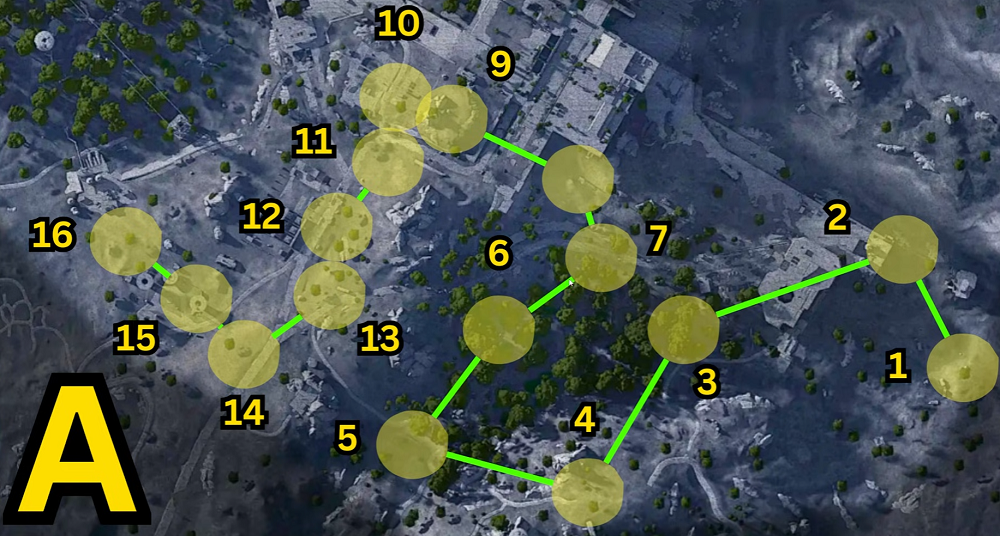
Route A (Southeast to West): Covers 16 spawn zones starting south of the radio tower near Formakai Hills, moving through the Testing Annex, Red Lakes balcony, Research and Admin, Water Treatment Control, the electrical substation, and the water towers area. Highlights include the area south of the electrical tower (A1), the forest west of the Testing Annex (A3), multiple spawn zones in Formakai Hills (A4, A5, A14), north of Scrapyard (A6 - this area can sometimes spawn two caches very close together), and the fields northwest of the water towers (A16).
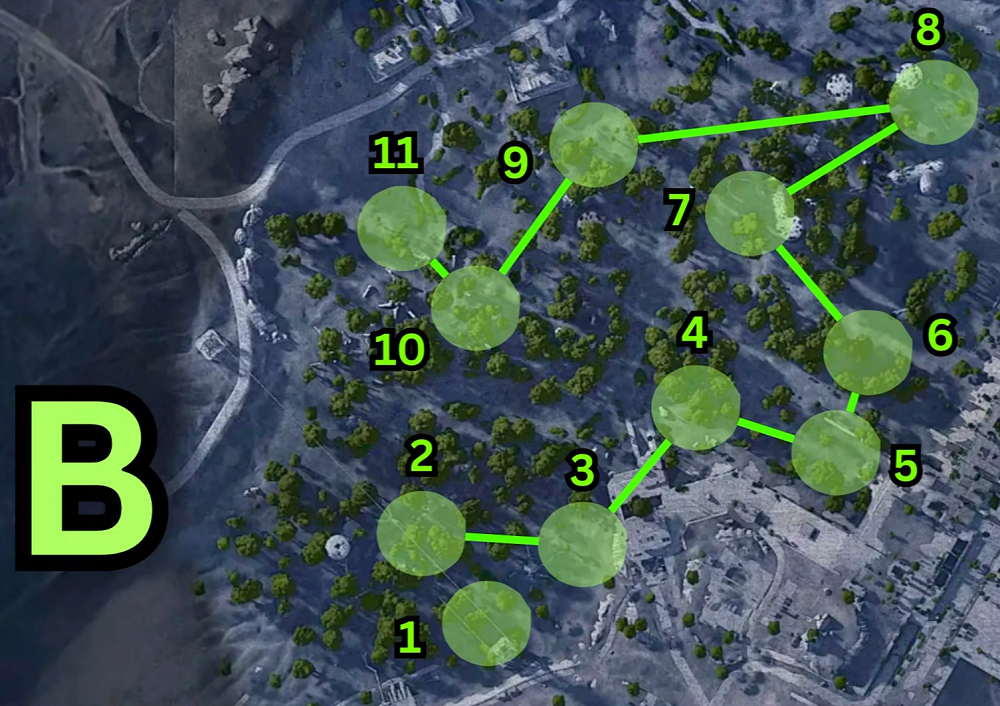
Route B (South to Northeast): Covers 11 spawn zones from the South Swamp Outpost area up through Water Treatment Control, the primary facility side of the dam, Hydroponic Dome Complex, Ben Welder Sunroof, and Old Battleground. The Hydroponic Dome Complex area (B7, B8) has multiple spawn points around its western and northeastern sides. Old Battleground (B10, B11) features several zones including a scrap building, a lookout spot, and the river stream to the north.
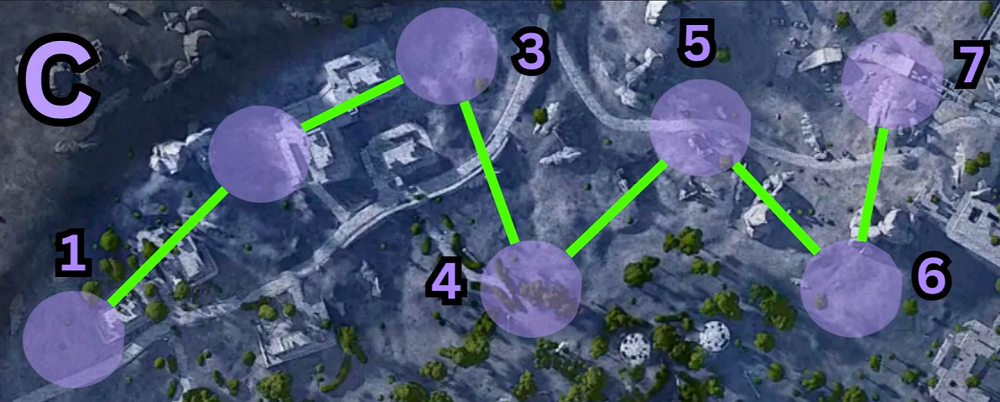
Route C (West to Central): Covers 7 spawn zones from the Pale Apartments through Ruby Residence, Victory Ridge, the west side of the Power Generation Complex, and the West Broken Bridge. The area west of the Power Generation Complex (C6) is notable because it frequently spawns two caches close together, possibly two overlapping spawn zones.
Route D (North to East): Covers 12 spawn zones starting at the Pattern House near the Power Generation Complex, moving through the eastern hills, the bridge area, Pipeline Tower, the dam breach, and down into the Red Lakes. The dam breach area (D7) can be risky since it's exposed. The Red Lakes structure (D8, D9, D10) has spawn points on both its eastern and western sides. The Raider Hatch in Red Lakes (D11) reliably has a spawn point very close by.
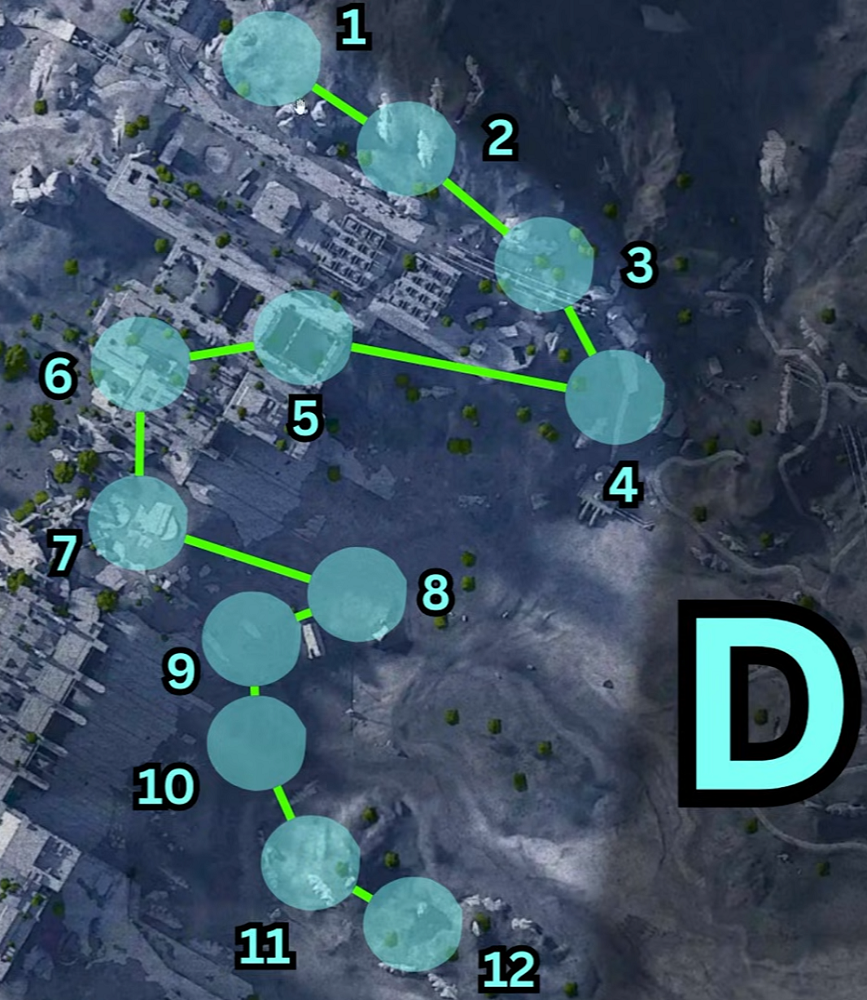
Route Design: Each route ends near where the next one begins. If you spawn in the South Swamp Outpost area, start with Route B. If you spawn near the Testing Annex, start with Route A. Adapt your starting point based on your spawn location and work through adjacent routes.
Blue Gate Raider Cache Locations
Blue Gate raider cache spawns are distributed across Gate Approach, Pilgrim's Peak, the highway area, the Ancient Fort, the village, Raider's Refuge, the ventilation shafts, Rapper's Glade, and the Adon Wreckage. The southern portions of the map near the refuge and the village tend to have multiple cache spawns in proximity. The highway collapse area and the zones around Pilgrim's Peak also hold reliable clusters.
Spaceport Raider Cache Locations
Spaceport raider cache locations cluster around the Arrival Building, Departure Building, and scattered zones near the trench hatches and elevated platforms. Some players note that Spaceport is the map they know least well for caches, but the distribution is reasonable if you learn the hatch locations and plan routes that end near extraction points.
Buried City Raider Cache Locations
Raider cache spawn points in Buried City are found near the Hospital, Town Hall, Space Travel, and Plaza Rosa areas. Buried City has fewer total spawn points compared to Dam Battlegrounds or Blue Gate, and the dense urban layout can make the ticking sound harder to isolate. It's a usable map for cache runs but not the most productive.
Stella Montis Raider Cache Locations
Stella Montis holds regular raider caches in the Medical Research area and Cultural Archives. Note that this map does not support hurricane caches since it's an indoor environment. For regular raider cache farming, Stella Montis works fine, but it is limited to standard loot.
ARC Raiders Raider Cache Loots
Regular raider caches carry gear that's useful for mid-raid gearing or early progression but rarely life-changing:
Weapons: Common to rare tier (green and blue quality). Expect items like Renegade 1–2, Berlet 1–2, and similar mid-range firearms.
Ammunition: Various ammo types for different weapon classes.
Healing Items: Basic bandages and shots. Occasionally sterilized bandages.
Components: Standard mechanical and electronic components. Rare items like processors appear occasionally.
Occasional Upgrades: Blue-tier items or useful mods show up from time to time but are not common.
Uncovered Caches Event
Once per day, an Uncovered Caches event runs for one hour. During this event, raider cache loot improves noticeably, and spawn rates seem slightly better. However, the caches also explode and disappear on a timer during this event, adding urgency. If you time your raider cache runs to overlap with this event, you'll get better returns.
ARC Raiders Raider Cache Best Farming Routes & Strategy
Spawn-Based Routing
The most effective approach to raider cache farming is to adapt your route based on where you spawn. Rather than memorizing one fixed route, learn the general clusters on each map and start at whichever cluster is closest to your spawn point.
On Dam Battlegrounds, the four-sector system (A, B, C, D) works well. Each sector is designed to chain into the next, so once you clear the nearest sector, transition into the adjacent one. On other maps, identify 3–4 high-density clusters and connect them with the shortest travel path.
Listen First, Move Second
At each spawn zone, stop briefly and listen for the ticking sound. If you hear it, hone in on the source. If nothing is audible after a few seconds, move to the next zone. This method is significantly faster than visually scanning every possible spot.
Bring Adrenaline Shots
Even outside hurricane conditions, covering a full route takes time. Adrenaline shots keep your stamina topped off so you can maintain sprinting pace across the map. Five to eight shots is usually sufficient for a standard raid.
Open ARC Couriers Along the Way
While running between cache locations, keep an eye out for ARC Couriers. These smaller containers can hold Surveyor Vaults and Sentinel Firing Cores — both of which are needed for workbench upgrades. They're easy to miss if you're focused on caches, but the loot is worth the two seconds it takes to open them.
Use Raider Cache Runs to Learn Hurricane Spawn Points
Since hurricane caches and raider caches share the same spawn zones, running regular raider cache routes during normal weather doubles as preparation for hurricane farming. Memorize the spawn zones during calm conditions so that when the hurricane hits, you already know exactly where to check without relying as heavily on external maps.
Recommended Farming Locations Outside of Caches
For players chasing specific blueprints like the Canto SMG, raider caches aren't the only option. Standard high-tier loot areas on each map also have a chance to drop blueprints:
Dam Battlegrounds: Dome Complex, Control Tower
Buried City: Hospital, Space Travel, Town Hall
Spaceport: Arrival Building, Departure Building
Blue Gate: Gate Approach, Pilgrim's Peak
Stella Montis: Medical Research, Cultural Archives
Security lockers, weapon cases, and containers in these areas have a higher chance of dropping blue-tier and above loot. Night raids also improve loot quality across the board. Weekly trials occasionally reward blueprints as well, so check those regularly.
Hurricane Cache vs. Raider Cache
| Hurricane Cache | Raider Cache | |
|---|---|---|
| When It Spawns | Hurricane map condition only | Every raid, any weather |
| Sound | Electric hum / buzzing | Mechanical ticking |
| Blueprint Drops | Tempest, Bobcat, Vulcano, Canto, Vita Spray, Explosive Mine | Rare, low chance |
| Weapon Quality | Level 3–4, purple tier | Level 1–2, green/blue tier |
| Healing Items | Vitashots, Sterilized Bandages, Defibrillators | Basic bandages |
| Best Map | Dam Battlegrounds or Blue Gate | Dam Battlegrounds |
| Available on Stella Montis | No | Yes |
| XP Per Cache | 700 | 700 |
Knowing where both cache types spawn gives you an edge no matter what map condition you load into. Run regular cache routes to build map knowledge, then switch to hurricane farming when the event cycles in, your prep time will pay off.